

More than 370 of Zimbabwe’s pension funds faced dissolution at the end of last year, according to the Insurance and Pensions Commission (Ipec)’s report for the nine months ended September 30, 2025.
Detailing a sombre operating environment, Ipec said more than half of Zimbabwe’s registered occupational pension funds were inactive.
Analysts said this scenario directly threatens the future benefits of thousands of employees.
Ipec said there are 968 registered occupational pension funds in the country.
“As at September 30, 2025, there were 968 registered occupational pension funds, unchanged from the 968 recorded as at June 30, 2025,” it said.
“Out of 968 registered funds, 479 (49,5%) were active, while 489 (50,5%) were inactive. Among the inactive funds, 372 (76%) were awaiting dissolution.”
The report also confirmed the deregistration of the National Aids Council, Trust Holdings, the Zimbabwe Broadcasting Corporation, and the Zimbabwe Energy Regulatory Authority pension funds.
Deregistration occurs when a fund ceases operations and cancels its registration. Ipec emphasised that even inactive funds are required to continue reporting until they are formally dissolved.
- UK based Zimbabwean divorces wife of 33 years over conjugal rights
- New perspectives: Money laundering red flags in insurance sector
- 3 000 non-resident pensioners owed US$1.5 million, says Ipec
- Removing barriers to women’s financial inclusion
Keep Reading
The process of dissolution and deregistration is governed by the Pension and Provident Funds Act.
Ipec said sponsors and administrators of pension schemes were required to ensure all funds were appropriately registered and hold a valid registration certificate.
“Registration must precede remittance of contributions and commencement of any administrative activities or operations. Moreover, each fund must be reported on, regardless of its status or condition,” the regulator said.
Despite the high number of dormant funds and the attendant risks to members, the report highlighted pockets of resilience within the active segment of the pension industry. Total pension contributions for the quarter rose sharply to US$225,89 million, up from US$148,35 million recorded in the same period last year.
In addition, the value of unpaid pension contributions owed by employers declined by 9%, pointing to improved compliance with payment schedules among functioning schemes.
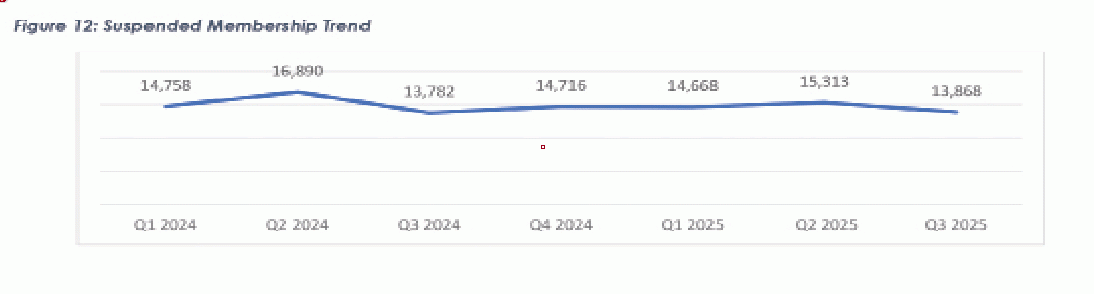
The regulator also reported a 17% increase in total membership, including beneficiaries, from one million to 1,2 million. This growth was largely driven by the reinstatement of 178 988 dormant members under the Construction Industry Pension Fund, alongside 6 582 new entrants across the sector.
Zimbabwe’s pensions sector has faced significant challenges over the past two decades, navigating prolonged periods of hyperinflation, currency instability, and economic volatility.
These conditions have placed severe strain on retirement savings vehicles, complicating their management and long-term sustainability.