
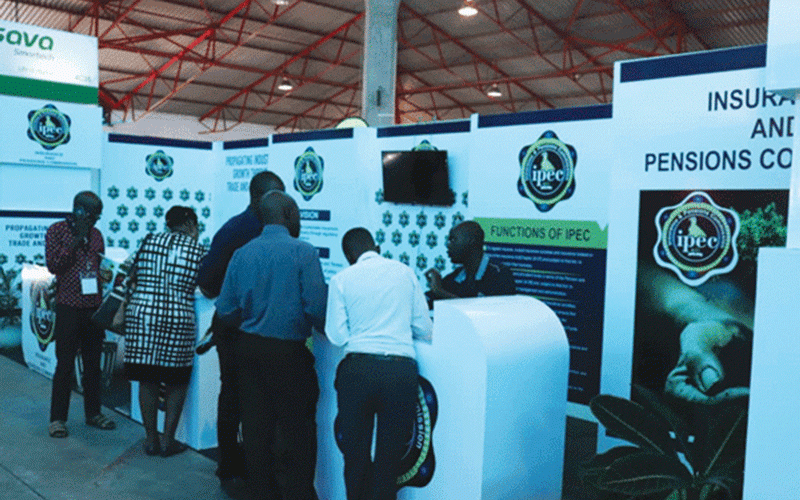
A flood of policyholder complaints reached regulators last year as short-term insurers struggled to settle claims, according to the Insurance and Pensions Commission (Ipec).
The Zimbabwe Independent reported in November that a wave of company closures in 2024 hammered the country’s fragile economy, pushing the insurance sector to the brink. Liquidity pressures forced several insurers to pay claims in instalments, a situation confirmed at the time by a joint assessment from four financial regulators and the Ministry of Finance, Economic Development and Investment Promotion.
The Reserve Bank of Zimbabwe (RBZ), the Deposit Protection Corporation, Ipec, and the Securities and Exchange Commission warned in the 2024 Annual Financial Stability Report that the cascading collapse of corporate clients — once the backbone of premium inflows — had triggered severe revenue shocks for insurers and pension funds.
Ipec’s short-term insurance report for the nine months ending September 30, 2025, highlighted a continuing surge in complaints.
“Delays in the settlement of claims were the major source of complaints, constituting 48% of the grievances,” the commission said.
“From January to September 2025, we received 113 complaints against the sector, a 10% increase from 103 complaints during the same period in 2024. Of these, 109 were against short-term insurers, two against insurance brokers, and two against the Insurance Council of Zimbabwe,” Ipec noted.
The third quarter alone accounted for 48 complaints, up 30% from 37 in the same period in 2024. Forty of these cases were resolved by the end of September, leaving eight still in progress.
In November, regulators revealed that liquidity pressures were so acute that claims were being paid “in drip and drabs.” Globally, a properly functioning insurance sector pays verified claims promptly and in full, relying on prescribed capital and liquidity buffers. Instalment payments are usually reserved for catastrophic events or temporary reinsurance delays. Their routine use in Zimbabwe signals deep liquidity stress, weakened balance sheets, and eroded capacity to honour obligations, analysts said.
- UK based Zimbabwean divorces wife of 33 years over conjugal rights
- New perspectives: Money laundering red flags in insurance sector
- 3 000 non-resident pensioners owed US$1.5 million, says Ipec
- Removing barriers to women’s financial inclusion
Keep Reading
For policyholders, instalment-based settlements can be devastating. Businesses cannot repair assets on time, households struggle to replace damaged property, and delays compound the very risks insurance is meant to mitigate. In many markets, such behaviour would trigger heightened regulatory scrutiny, rehabilitation, or curatorship.
The 2024 regulators’ assessment showed 10 of 19 short-term insurers and two of 10 reinsurers had negative working capital and current ratios below 100%, signalling potential difficulties in meeting immediate obligations. Undercapitalisation and governance gaps prompted regulators to call for heightened oversight.
However, the 2025 third-quarter report showed significant improvement in capitalisation across the sector, with Ipec confident in the industry’s overall stability. The informalisation of the economy, however, continues to erode insurance coverage, pension penetration, rental yields, and commercial property valuations. With ongoing corporate closures — particularly in the retail sector — risks are expected to persist.
On direct insurance companies, the 2025 report indicated that 21 registered insurers reported total insurance revenue of ZiG6,07 billion (US$227,52 million) for the nine months ending September 30, representing a 24% increase from US$182,91 million in the same period of 2024.
Revenue from credit insurance and bonds/guarantee insurance rose sharply, by 114% and 53% respectively. Growth in credit insurance reflected heightened perception of credit risk, prompting businesses to purchase coverage against potential losses.
The increase in bonds and guarantee insurance indicated growing demand for financial guarantees and surety bonds, enhancing transaction security, facilitating large-scale projects, and meeting contractual obligations.
“Short-term insurers reported foreign currency-denominated insurance revenue of US$176,45 million for the nine months ended 30 September 2025, up 15% from US$153,97 million in September 2024. Foreign currency business accounted for 77% of total revenue,” the report said.
Revenue from public liability and farming insurance grew by 86% and 60%, respectively. The “Others” class, largely credit insurance, posted a 219% increase. In contrast, aviation insurance revenue fell 38%, highlighting contraction in the line of business.
Despite these pockets of growth, analysts caution that liquidity pressures, payment delays, and underlying economic risks continue to weigh on the sector. Instalment-based claim settlements remain a signal of structural stress in the sector, according to analysts, while regulatory vigilance remains essential to maintain stability.
Zimbabwe’s short-term insurance market is thus navigating a precarious path: while businesses adapt and demand for risk coverage rises, the sector must contend with delayed claim settlements, undercapitalisation risks, and vulnerabilities arising from the broader economy. Analysts said for policyholders in Zimbabwe, one lesson was standing out; “Insurance is only as reliable as the balance sheets behind it,” said one of the analysts.