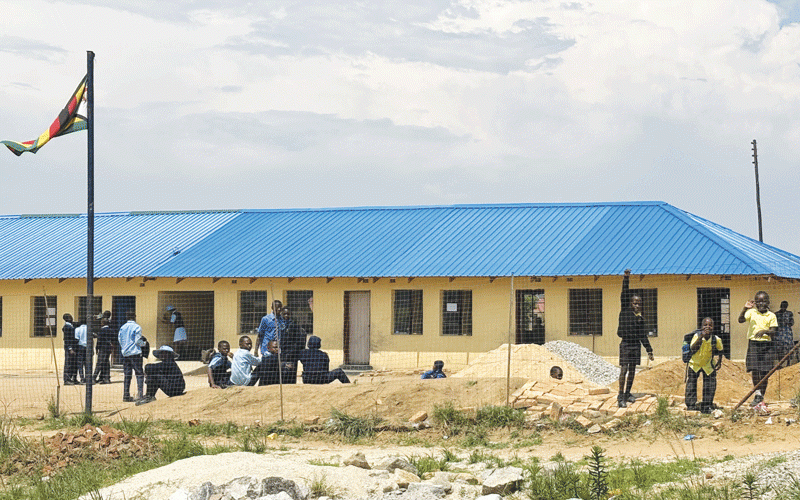
ZIMBABWE spent about US$4,7 million on schools construction over six years but delivered only 242 facilities against a target of 1 800, leaving 1 558 institutions unbuilt despite near-full utilisation of public funds, a 2025 Auditor-General’s audit has revealed.
The findings are contained in a 2025 Value for Money audit of the Ministry of Primary and Secondary Education covering the period 2018 to 2023.
During that time, Treasury budgeted ZW$4,95 billion, about US$5 million, and released ZW$4,68 billion, about US$4,7 million, for school construction, based on the average official interbank exchange rate prevailing in 2023 of about ZW$1 000 to US$1.
The ministry reported that all released funds were utilised, with about ZW$900 million, roughly US$900 000, not funded.
Acting Auditor-General Rheah Kujinga said the gap between planning, spending and delivery was persistent.
“Schools were not being constructed as per the plan,” Kujinga said. “The ministry was targeting to construct 300 schools per year, translating to 1 800 schools for the six-year period under review. However, only 242 schools were constructed.”
Using the interbank conversion, the US$4,7 million spent implies an average cost of about US$19 400 per completed school, a figure that contrasts sharply with the widespread delays, stalled projects and abandoned sites documented in the audit.
Kujinga said slow execution had directly worsened overcrowding.
- Sakunda hail SA stadia tour
- Rufaro Stadium refurb gathers momentum
- Huge incentives for DeMbare, Bosso
- Chiri vows to stop looting
Keep Reading
“Delays to execute the construction plans resulted in overcrowding in schools,” she said, adding that the ministry had resorted to satellite schools and hot-seating arrangements that were “not conducive for learners”.
Provincial performance varied but remained weak. Harare completed 17 schools out of a target of 180 over six years, while Bulawayo managed just 10. Nationally, the ministry achieved only 13% of its construction target.
Despite the scale of spending, the auditor-general found that none of the eight Public Sector Investment Programme projects sampled in Harare, Manicaland and Bulawayo had been completed.
Some projects stalled for four to six years, while others had not progressed beyond foundation level.
“I noted that there were delays in the completion of construction projects,” Kujinga said. “Some construction works had stopped for more than five years.”
The audit highlights cases where materials were procured years before use, including roofing materials bought in 2019 for buildings that were still at foundation level in 2023.
In other instances, contractors abandoned sites after requesting price variations linked to inflation, requests that remained unresolved.
“At Magamba Primary School, the contractor requested a price variation of 7% citing inflationary pressures,” Kujinga said.
“The ministry had not yet responded, and the school remained uncompleted at the time of audit.”
The consequences are borne by pupils. Zimbabwe now has more than 9 000 satellite schools, many of which have operated for over a decade.
In some urban schools, classrooms accommodate more than 90 pupils, forcing three-session days and outdoor learning.
“The inadequate execution of the construction plans has resulted in learners attending lessons under trees and in overcrowded classrooms,” Kujinga said, noting that this was contrary to the ministry’s own infrastructure standards.
The audit also flagged governance weaknesses, including the non-functionality of a national project management committee and inadequate supervision of contractors, which in some cases led to substandard buildings being condemned after completion.
Responding to the audit, the Ministry of Primary and Secondary Education acknowledged the shortage of schools and the pressure on existing infrastructure.
Management attributed delays to funding constraints, inflationary pressures, and the involvement of multiple stakeholders in the construction process.
The ministry said satellite schools were a strategic intervention to ensure access to education, particularly in areas where learners would otherwise walk long distances.
It also cited support from development partners through school improvement grants and said it was mobilising additional resources through public-private partnerships.
However, Kujinga urged the ministry to align ambition with capacity.
“The Ministry should come up with realistic plans for construction of public schools that are in line with the availed resources,” she said, adding that projects already started should be completed before new ones are launched.
With about US$4,7 million spent at interbank rates and more than 1 500 planned schools still missing, the 2025 audit raises uncomfortable questions about value for money, execution capacity and accountability in one of the government’s most critical social investment programmes.