

A MAJOR confrontation is looming between government and key economic sectors over the newly-introduced 15% Digital Services Withholding Tax, with banks and business leaders warning that the measure is operationally unworkable, inflationary and out of step with the global push towards digitalisation.
At the centre of the dispute are measures unveiled in the 2026 national budget, which took effect on January 1 and imposed a 15% value-added tax on payments made to non-resident digital service providers.
The tax targets services consumed in Zimbabwe but supplied by offshore platforms. These include streaming services such as Netflix and Spotify, ride-hailing applications, satellite internet subscriptions such as Starlink, and other digital services. Such subscriptions have expanded rapidly over the past decade as the country’s digital infrastructure has grown.
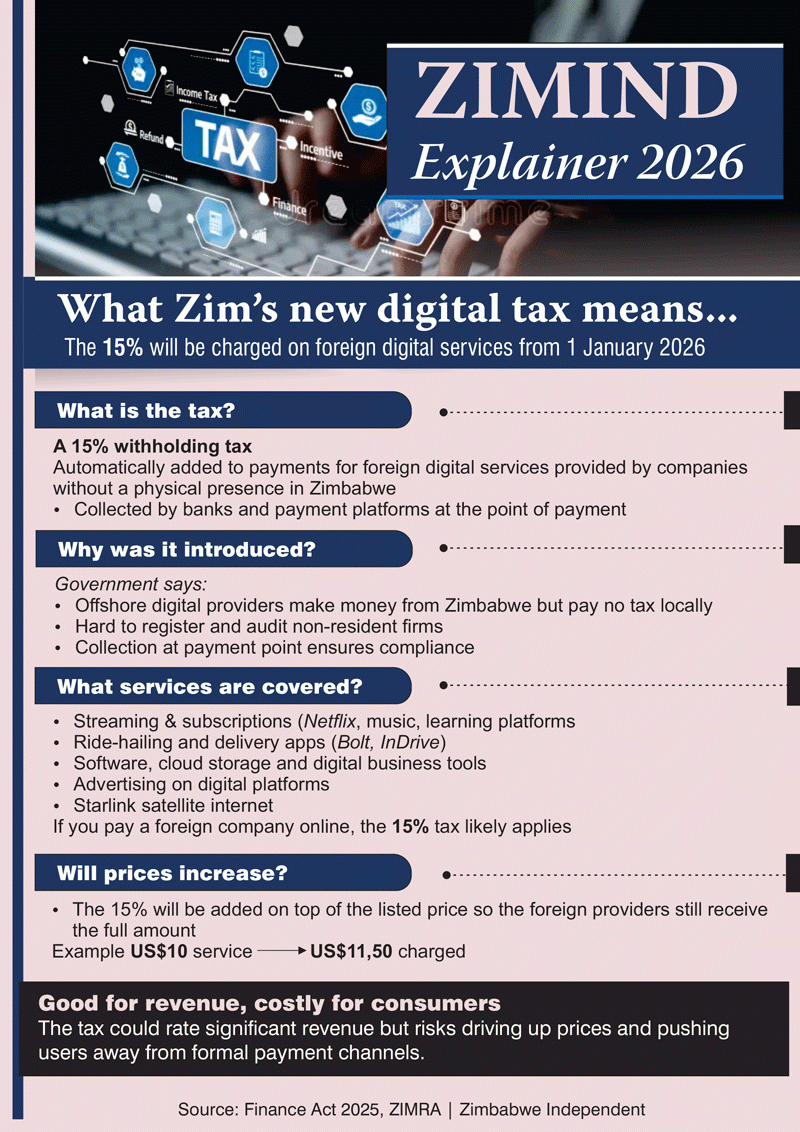
Unlike conventional VAT regimes, the tax shifts the burden of collection away from foreign suppliers. Instead, domestic financial intermediaries — banks and mobile money operators — are required to withhold the 15% levy at the point of payment and remit it to the tax authority.
Finance, Economic Development and Investment Promotion minister Mthuli Ncube has defended the approach as a pragmatic solution to taxing hard-to-reach offshore suppliers, arguing that it protects the revenue base and creates competitive neutrality with local firms already subject to VAT.
But the model has triggered swift and intense backlash across the economy, led by the banking sector, which says the policy is fraught with legal, operational and systemic risks.
“From a banking perspective, the 15% digital services tax presents significant practical and operational challenges. The biggest concern is implementation,” a senior banker, who spoke on condition of anonymity due to ongoing engagements with authorities.
- Letters to the editor: PVOs Bill must be shot down
- KIFC eyes Zim financial sector
- Queen Lozikeyi singer preaches peace
- New perspectives: Impact of tax policy on gender equality
Keep Reading
“Banks are still grappling with how the tax is meant to work in practice, and until there is clearer guidance, compliance risks remain high.
“The legislation leaves too much open to interpretation, creating uncertainty around what exactly should be taxed and how the tax should be applied,” he added.
In separate interviews by the Zimbabwe Independent, bankers warned that the tax could fundamentally alter customer behaviour, with early signs that some users are already seeking foreign-domiciled cards or alternative payment channels to avoid the charge.
“This could have unintended consequences for the formal payments ecosystem and financial transparency,” another top banker said.
A major concern is classification. Financial institutions say it is often unclear which international card transactions qualify as payments for taxable “services” under the law.
“Without precise definitions, banks face the risk of either under-collecting the tax and falling foul of regulators, or over-taxing transactions ato avoid compliance breaches, effectively penalising customers,” the banker said.
These challenges are compounded by the absence of explicit clarity in the Act on the applicable rate and scope, complicating systems configuration, reporting and audit processes.
Another senior banker, who also asked not to be named, criticised both the timing and the scale of the levy, describing it as counter-productive.
“The introduction of a 15% digital services tax is not only operationally difficult but also fundamentally retrogressive at a time when the global financial system is accelerating towards deeper digitalisation,” he said.
“Introducing a punitive tax at this stage risks reversing those gains by discouraging digital transactions and pushing activity back into less efficient or informal channels.”
The rate itself has become a flashpoint. Critics note that Zimbabwe’s 15% charge is far higher than comparable regional digital taxes — Kenya levies 1,5%, Uganda 5%, Tanzania 2%, Tunisia 3% and Nigeria 6% — raising fears of a sharp overnight increase in the cost of digital services.
Business leaders warn the impact will be felt well beyond banks.
Zimbabwe National Chamber of Commerce chief executive Christopher Mugaga said the tax would directly feed into higher prices
“It means minimum prices are going to increase by 15%. This is going to increase service inflation, telecoms inflation and the cost of doing business which is what we don't want especially when we are on the road to promote digitalisation,” he said.
Jacob Mutisi, chairperson of the Zimbabwe Information and Communication Technology Division, warned of a cascade of negative effects, including avoidance behaviour and a revival of informal markets.
“The tax will “increase the cost of doing business and accessing services, encourage avoidance through diaspora-based payments and cash transactions, push users away from formal banking channels, revive the parallel market, and return to black market activity,” he said.
He cautioned that while taxing the digital economy is necessary, “over-taxation risks driving transactions underground, undermining both revenue collection and financial inclusion”.
Tech expert Evans Sagomba said the structure of the levy risks double taxation for domestic consumers, while Confederation of Zimbabwe Retailers president Denford Mutashu pointing out that the punitive rate could undermine voluntary compliance.
"A bare maximum 1,5% was recommended in an economy trying to persuade the population to move from cash based transactions evading detection and compliance with laws. Punitive tax regimes may push illicit transacting," he said.
Tax technology firm VATCalc said Zimbabwe’s move aligns with a regional trend to tax non-resident suppliers, but warned the 2026 reform carries significant trade-offs.
“It represents a significant step toward formalising this principle, albeit with trade-offs that will require careful monitoring of consumer behaviour, revenue performance and market dynamics in the first year of implementation,” the firm said.
In response to mounting criticism, Ncube this week said the tax was a critical compliance tool designed to protect Zimbabwe’s tax base, ensure fairness and modernise revenue collection in line with the digital economy.
“The Ministry has noted communication suggesting that the tax applies uniformly to all international card transactions irrespective of the underlying supply,” he said.
“This interpretation is inconsistent with the policy or legislative intent. Engagements with financial institutions are ongoing to ensure consistent and correct application, limited to imported services excluding goods.”
Ncube clarified that the tax did not apply to imported physical goods or online purchases of tangible products, noting that within the digital services framework the term “goods” refers only to electronically supplied or digitally mediated services.
To prevent double taxation, he said taxpayers already correctly accounting for VAT on imported digital services under the VAT Act would not be liable for the withholding tax on the same transactions.
The levy applies to all offshore payments for imported digital services processed through regulated financial intermediaries in Zimbabwe, regardless of whether they are made via international cards, mobile platforms or other payment channels.