AS we publish our final edition of the year, this is not a story to be postponed, sanitised or deferred.
The year 2025 will be remembered as one of the darkest for journalism in Zimbabwe, marked by arrests and the incarceration of journalists. Two of us were imprisoned. One of them was me.
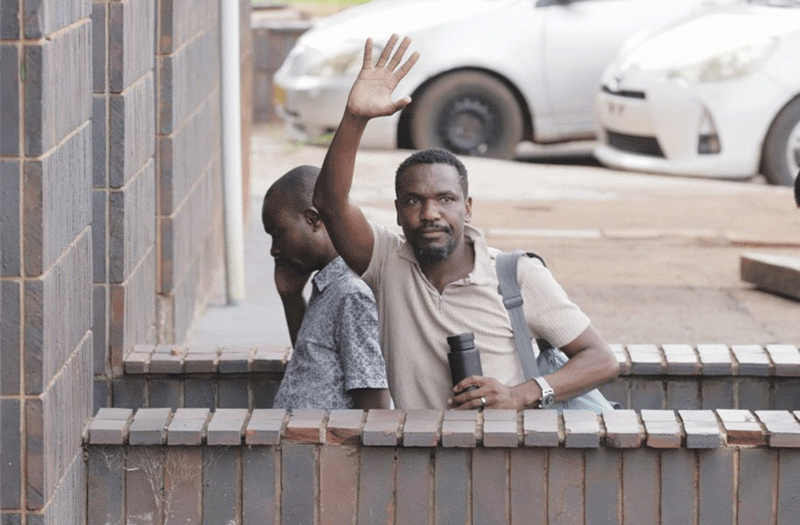
Blessed Mhlanga, a senior journalist at Alpha Media Holdings (AMH), was arrested and charged with “transmitting data messages that incite violence or damage to property” under Zimbabwe’s Cyber and Data Protection Act.
He spent 72 days in pre-trial detention before being granted bail on May 7, 2025. His trial began this month but has since been postponed to January 12 and 13.
As the year draws to a close — a year that was traumatic, dehumanising and deeply sobering for both Blessed and myself — it is no longer enough to report on prison conditions from a distance.
What we witnessed, endured and survived demands to be told, not as a tale of personal suffering, but as an urgent indictment of a system that continues to brutalise the powerless. This is why, for the first time, I share my experience from inside Zimbabwe’s prisons — not for sympathy, not for spectacle, but to compel those in authority to admit a truth they have ignored for far too long: our prisons are a national shame.
That reckoning began on July 1, when I was summoned to Harare Central Police Station by the Law and Order Department. After nearly five hours with detectives and my lawyer, Chris Mhike, a senior officer walked into the room and spoke.
His words were blunt and chilling: “This is beyond us. We have been ordered to detain you. We now have to take you to the police cells.”
- The only market where knowledge exchange is part of customer experience
- Dave Chappelle: US comedian attacked on stage in Los Angeles
- AMH investor forum to explore Zim opportunities
- Letter to my people: The experiment has failed spectacularly
Keep Reading
I was being charged under Section 33 of the Criminal Law (Codification and Reform) Act for allegedly insulting or undermining the President. The words struck like a hammer blow. I felt numb, hollow. As we walked down the dark hallways of Harare Central Police Station, I felt as though I was floating, watching it all in disbelief.
I had written countless stories about the filthy conditions of police cells. I never imagined I would one day be locked up.
I was sick and frail — my skin darkened, my legs swollen and my mouth unbearably dry. That night became the first of the three longest of my life. The stench in the cell was overpowering — thick, suffocating and unforgettable. A raised, filthy toilet stood in the corner, wrapped in a dirty blanket that did little to mask the reek.
Women lay sprawled on the cold concrete floor, barefoot, stripped of dignity. We were allowed only one top item of clothing, but not a puffer jacket. Outside, temperatures dropped to seven degrees Celsius. Inside, the cold cut through bones. I shivered, counting the hours until daylight.
Morning did not bring freedom. I was remanded to Chikurubi Women’s Prison. The drive, in a cramped van with male inmates from Harare Remand Prison, was long and heavy with dread, my anxiety growing with every kilometre. What hurt even more was driving past my home.
Inside Cell 3, more than 40 women were packed into a single space, forced to share one toilet that did not flush. Inmates plunged human waste by hand, pouring water from buckets until it dissolved.
The smell lingered in the air — unbearable, clinging to skin and breath. No matter how deeply beneath the covers I buried myself, it was inescapable. We slept on bare concrete, sharing three thin blankets. We bathed in icy water, shivering as temperatures dropped to between six and eight degrees Celsius.
Many women had no jerseys and endured the days shivering in thin prison clothes, receiving the red-and-white striped jerseys only when they appeared in court.
Meals offered no comfort. Mornings brought a bucket of watery tea, poured into a single cup passed from hand to hand. The fortunate used empty bottles scavenged from the yard. With it came two slices of bread. Lunch was sadza and vegetables; supper, sadza and sugar beans — all served on bucket lids.
And yet, I reminded myself: I was not the first to endure this. Our liberation leaders — the men and women who now walk the corridors of power — once slept on the same cold floors, breathed the same stench and swallowed the same prison food.
They endured it and vowed that no Zimbabwean would ever again suffer such indignity. But 45 years after independence, our prisons are still dungeons of despair, factories of humiliation.
The United Nations Basic Principles for the Treatment of Prisoners state that all prisoners shall be treated with the respect due to their inherent dignity and value as human beings.
Imprisonment is the punishment — not the deprivation of health, humanity and hope. Yet in Zimbabwe, prison conditions routinely trample these principles.
Overcrowding, poor sanitation and nutrition, inadequate healthcare, and exposure to extreme temperatures have turned sentences into slow torture. Imagine serving years in such conditions.
Prison should never mean that inmates lose their dignity, nor that we, as a society, surrender our own humanity.
It is time for those in power to remember their past — the cold concrete floors, the gnawing hunger, the stench of overflowing toilets — and allow memory to summon conscience. Prisons are not meant to dehumanise; they are meant to rehabilitate.
A society is not judged by how it treats the powerful, but by how it treats its weakest, its forgotten, even its condemned. By that measure, we are failing.
Yet it is not too late. Dignity can still be restored behind prison walls. Conditions can still be improved. Humanity can still be reclaimed.
Because power is fleeting. Today’s authority can become tomorrow’s prisoner — or the parent of one. Let 2026 be the year we choose dignity over neglect, reform over indifference and humanity over cruelty.
Our prisons are our conscience. Right now, that conscience is in chains.