South Africa’s 2024 general election did not merely dent the African National Congress (ANC); it also detonated the myth of its invincibility.
Once the towering liberation giant that embodied the triumph over apartheid, the ANC limped into coalition politics with a paltry 40,18% of the vote. This implosion is not merely a South African reckoning but a continental siren, warning of a broader unravelling.
Across Africa, liberation aristocracies that once monopolised power now peer into the same abyss of inevitable decline as their historic aura of sovereignty is eroding, and in its place looms the darker path of authoritarian relapse, where liberation credentials are weaponised to mask corruption, repression, and the hollowing out of democratic promise.
The ANC’s fall is not an isolated stumble but the loudest alarm bell yet. The golden age of liberation monopolies is ending, and the sensation of eternal legitimacy, built on the sacrifices of anti-colonial struggle, is evaporating under the weight of corruption, generational disillusionment, and urban discontent.
What is collapsing in South Africa is not just a party but a political model and the idea that liberation credentials alone can indefinitely substitute for democratic renewal.
This moment demands to be read as a continental turning point. The ANC’s unravelling is a mirror held up to Africa’s liberation movements, exposing their fragility and foreshadowing a new era where youth agency, urban frustration, and demands for sovereignty will no longer be pacified by the nostalgia of struggle.
Clearly, the liberation script in its original form is exhausted, and the curtain is rising on a new and uncertain play.
- Open letter to President Mnangagwa
- Feature: ‘It’s worse right now than under Mugabe’: Sikhala pays the price of opposition in solitary cell
- Masvingo turns down fire tender deal
- Human-wildlife conflict drive African wild dogs to extinction
Keep Reading
South Africa’s 2024 general election marked the most dramatic rupture in the post apartheid order. The ANC plunged from 57,5% and 230 seats in 2019 to just 40,18% and 159 seats, stripped of its ability to govern alone for the first time since 1994.
This collapse exposed the fragility of its dominance, long corroded by corruption, scandals, state capture, and patronage networks that enriched elites while citizens endured blackouts, water shortages, and failing infrastructure.
Once synonymous with liberation, the ANC has become shorthand for mismanagement, its historic credentials drowned in graft. Economic stagnation and staggering youth unemployment further shredded its credibility, leaving millions disillusioned.
Into this vacuum surged splinter forces, COPE after Polokwane, the Economic Freedom Fighters (EFF) after Malema’s expulsion, and most recently Zuma’s MK Party, which stunned the landscape with 14,58% and fifty-eight seats, cannibalising the ANC’s base.
Polokwane in 2007 remains the watershed that dethroned Mbeki, elevated Zuma, and entrenched factionalism as the ANC’s defining feature. What was hailed as grassroots renewal became the seed of decline, hollowing state institutions and birthing splinter parties that exposed ANC vulnerability.
Malema’s expulsion in 2012 accelerated this trajectory, catalysing the EFF and reshaping youth politics.
Zuma’s MK Party has now delivered the most consequential rupture since Polokwane, fracturing ANC dominance and forcing coalition politics. Taken together, these breaks chart the ANC’s descent from liberation movement to fractured organisation, trapped in perpetual legitimacy crises.
Meanwhile, the DA’s consolidation at 21,81% in 2024 underscored the ANC’s urban decline, reframing the contest as one between liberation nostalgia and governance credibility.
More than a numerical challenge, the DA represents a structural threat, stripping the ANC of unilateral authority and accelerating the transition to contested pluralism.
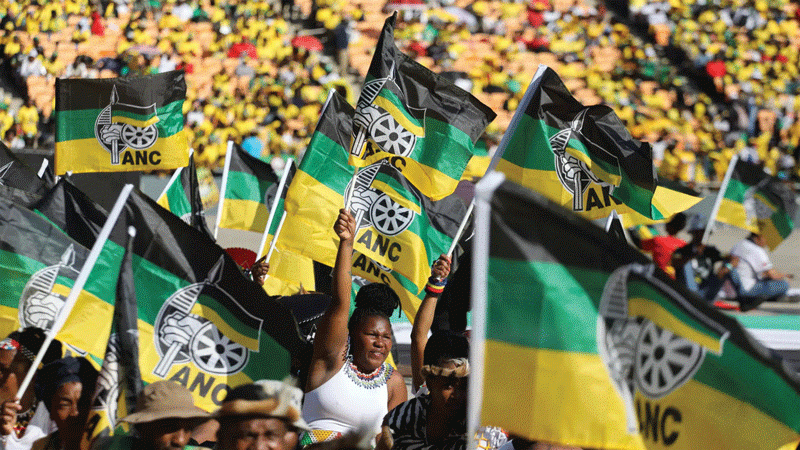
The ANC’s failure to fill Moruleng Stadium in 2026 crystallised this unravelling as empty seats where throngs once gathered now stand as a warning that, unless corruption, factionalism, and mismanagement are confronted, the liberation party risks collapsing further into irrelevance and being remembered more for its decline than its triumph.
The rise of political opportunists
Since South Africa entered into a Government of National Unity, the ANC’s diminished authority has been laid bare, because its once unchallenged grip is now openly weakened by coalition compromises and the loss of outright majorities in key provinces.
Into this vacuum have surged far-right currents, testing the boundaries of power and legitimacy.
Most visibly in the Western Cape, secessionist movements such as the Cape Independence Advocacy Group and the Referendum Party have seized upon anti-ANC sentiment to advance a brand of ethno-regional populism steeped in the discredited logic of apartheid.
Their rhetoric reframes provincial grievance as destiny, exploiting the ANC’s erosion of dominance to push exclusionary visions that fracture the democratic project and threaten the cohesion of the republic.
The so-called “white genocide” agenda is propelled by opportunists, far-right movements, lobby organisations such as AfriForum and Solidarity, and amplified by segments of the US and European far right, who exploit farm murders to fabricate a narrative of racial extermination.
These forces thrive on grievance rather than vision, portraying ANC rule as irredeemably corrupt while peddling the illusion of “freedom from Pretoria”.
Their rhetoric, echoing global far-right slogans, corrodes democratic cohesion and entrenches exclusionary economics that pit provinces against one another.
By lobbying foreign powers and weaponising false grievances under the banner of “white genocide,” they imperil not only South Africa’s fragile unity but also the broader continental project of cohesion, equality, and democratic renewal.
Curse and opportunity
Coalition governance has become South Africa’s lived reality, shattering three decades of single-party dominance and thrusting the ANC into a paradox of weakness and renewal.
Across Africa, coalition experiments offer sobering lessons where Kenya’s fragile bargains often collapse into ethnic rupture; Zimbabwe’s unity government briefly eased economic pain before authoritarian relapse, and Lesotho’s coalitions consistently spiral into paralysis.
For the ANC, coalition politics is both a curse and a blessing, exposing its loss of legitimacy yet forcing long-absent checks and balances.
The future will depend less on seat arithmetic than on whether leaders transcend factional ego to embrace governance rooted in respect for law, constituencies, and the public good.
This crisis is not uniquely South African, but part of a continental unravelling of liberation movements once hailed as custodians of sovereignty. Zanu‑PF clings to power through repression.
In Angola, the MPLA scrapes by amid corruption and Unita’s rise, and in Namibia Swapo’s vote share collapses as younger generations question its relevance.
The sobering truth is that liberation parties, though deserving praise for dismantling colonialism, are eroding under corruption, stagnation, and generational discontent.
Survival demands moral renewal, succession planning, and genuine engagement with Gen Z under Millennial stewardship.
Without such reinvention, the memory of liberation risks being drowned in the hollow trappings of independence, leaving behind shells of movements that once embodied freedom.
Rallying Africa’s youth
Liberation movements must finally confront the truth that power is not an eternal entitlement but a fragile trust that must be justified by service to the people.
The moral high ground they once commanded in the crucible of liberation has been squandered through corruption, mismanagement, and the capture of the state by tenderpreneur elites and rent-seeking sycophants. The ANC, like Zanu-PF before it, has fallen from grace, losing the ethos of sacrifice and solidarity that once defined it. If this decline goes unchecked, the ANC, once a movement of workers, unions, and urban intellectuals, now risks degenerating into a rural rump party like what Zanu-PF has become, if it continues to be hollowed out by Jacob Zuma’s destructive populist implosion and estranged from the very constituencies that sustained its rise. South Africa’s strong constitutional scaffolding may prevent a descent into the lawless pseudo-democracy that Zimbabwe has become, but the warning signs are unmistakable.
Across Africa, election rigging allegations have plagued nations from Nigeria to Uganda, from the DRC to Cameroon, fuelling instability and eroding trust in democracy. South Africa must serve as a continental alarm bell that liberation monopolies are living on borrowed time, their legitimacy eroded, their moral compass broken. Unless they reform, they will retreat into the same authoritarian reflexes, vote buying, intimidation, and ballot stuffing that have disfigured Tanzania, Zimbabwe, most recently Uganda and others.
- Wellington Muzengeza is a Political Risk Analyst and Urban Strategist offering incisive insight on urban planning, infrastructure, leadership succession, and governance reform across Africa’s evolving post‑liberation urban landscapes.