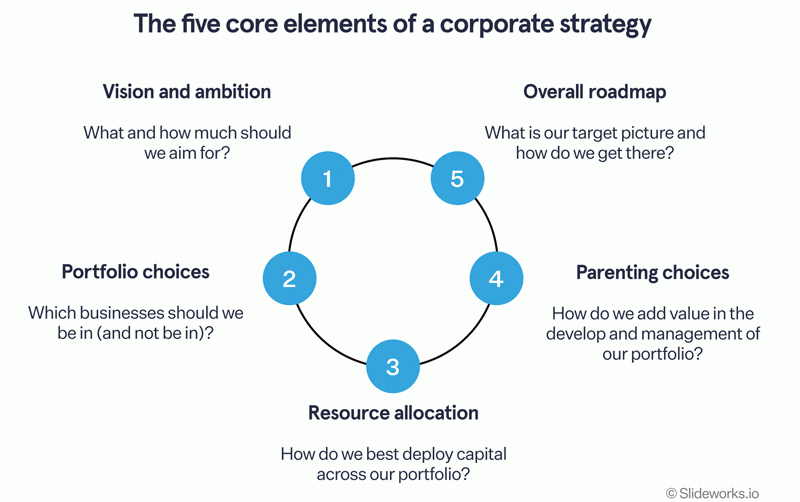
CORPORATE strategy is often treated as an event: A retreat, a deck, a consultant-led process culminating in a glossy document and a three to five-year plan.
Yet the uncomfortable truth is this, strategy does not begin with frameworks, workshops or budgets. It begins much earlier, in the quality of thinking an organisation cultivates long before it declares that it is “doing strategy”.
Where this thinking is absent, no amount of technical sophistication can rescue the outcome. The strategy, in such cases, is stillborn.
A good corporate strategy is not the product of process alone, it is the outcome of disciplined, rigorous and courageous thought. Strategy documents merely formalise what an organisation already knows, believes and is willing to confront about itself and its environment.
If those underlying beliefs are shallow, borrowed or suppressed by culture, the resulting strategy will be hollow, ambitious in language, timid in substance and disconnected from reality.
Thinking before planning
The most dangerous misconception in corporate life is that thinking and planning are interchangeable. They are not. Planning is an act of organisation, whereas thinking is an act of inquiry.
Planning arranges known elements into a coherent order. Thinking questions whether those elements are relevant in the first place.
When organisations rush into strategic development without prior thinking, they default to templates: Strengths, weaknesses, opportunities and threats analyses populated with platitudes, vision statements that could belong to any company and financial projections reverse-engineered to justify predetermined ambitions.
The exercise becomes one of validation, not discovery. Assumptions are confirmed, not tested. Comfort replaces curiosity.
True strategic thinking, by contrast, is uncomfortable. It asks questions that destabilise consensus:
- What business are we really in?
- What would make us irrelevant?
- Which of our strengths have become liabilities?
- What truths are we avoiding because they threaten existing power structures?
These questions cannot be answered in a three-day offsite, at a fancy lodge. They require time, reflection and psychological safety. They require leaders who value insight over alignment and inquiry over speed.
Pre-strategy work no one sees
The most important work of strategy is invisible. It happens in how leaders frame problems, how organisations process dissent and how decisions are debated when no consultant is in the room. Rigorous thinking before strategy involves at least four disciplines.
First, environmental sense-making: This is not a perfunctory pestle analysis but a deep interrogation of forces shaping the industry, such as, technology shifts, regulatory trajectories, customer behaviour, informal competitors and systemic risks. It requires reading widely, listening beyond the usual echo chambers and engaging with perspectives that challenge institutional optimism.
Second, honest self-assessment: Many organisations confuse aspiration with capability. Strategic thinking demands brutal clarity about what the organisation can and cannot do, where it has earned the right to play and where it is deluding itself.
This is less about benchmarking against peers and more about understanding one’s unique configuration of assets, culture and constraints.
Third, causal reasoning: Weak strategies list initiatives without explaining why they will work. Strong thinking traces cause and effect: If we do X, under what conditions will Y follow? What assumptions must hold true? What could break the chain?
Without this discipline, strategy becomes a catalogue of activities rather than a theory of success.
Finally, choice: Strategy is as much about what is deliberately excluded as what is pursued. Pre-strategy thinking must narrow options, not multiply them. Where everything is a priority, nothing is strategic!
Culture as silent architect of strategy
Even the most intellectually gifted leaders will fail to produce a good strategy in a culture that punishes independent thought. Organisational culture is the silent architect of strategy, as it determines which ideas surface that are suppressed and rewarded.
In many corporates, the stated commitment to innovation coexists with an unspoken intolerance for deviation. Employees quickly learn that originality is welcome only when it aligns with senior opinion, that questions are appreciated until they become inconvenient and that careers advance through agreement rather than insight. In such environments, strategy becomes an exercise in performance, not substance.
An enabling culture, by contrast, treats thinking as a shared responsibility, not a hierarchical privilege. It encourages dissent without disloyalty and debate without defensiveness. People are allowed and indeed expected, to think beyond their job descriptions, to challenge legacy assumptions and to propose ideas that may fail.
This does not imply chaos or lack of discipline. On the contrary, the most innovative organisations are often the most intellectually rigorous. They distinguish between opinion and argument, between intuition and evidence. Ideas are tested, not protected by rank.
Psychological safety, strategic depth
Innovation and creativity are not products of creativity workshops, they are outcomes of psychological safety. People do not think boldly when they are afraid of being embarrassed, marginalised or punished.
Strategic insight often comes from uncomfortable observations that a flagship product is obsolete, that a cherished partnership is extractive and that a revered leader’s intuition is outdated. If the organisational climate discourages such observations, they will remain unspoken until the market delivers its verdict.
Leadership behaviour is decisive here. Leaders who monopolise airtime, signal premature conclusions or reward compliance over candour, actively shrink the strategic intelligence of the organisation.
Conversely, leaders who ask genuine questions, change their minds in public and acknowledge uncertainty create space for collective thinking. It is, therefore, no coincidence that organisations with strong thinking cultures tend to outperform over time. They detect weak signals earlier, adapt faster and are less invested in defending past decisions.
From activity to insight
Another common failure in strategy development is the substitution of activity for insight. Long lists of initiatives give the illusion of momentum, but they often mask the absence of a coherent point of view.
Strategy is not a to-do list. It is a set of integrated choices about where to compete, how to win and what capabilities must be built or abandoned. These choices rest on insight, about customers, competitors, economics and organisational reality.
Insight cannot be outsourced. Consultants can facilitate, benchmark and challenge, but they cannot think on behalf of the organisation.
When leadership abdicates thinking to external advisors, the resulting strategy may be elegant but unowned. Implementation then falters, not because of execution failure, but because the organisation never truly believed in the logic.
Ownership arises when people recognise their own thinking in the strategy, when they see that their questions, debates and hard-won conclusions shaped the outcome. This is why inclusive thinking processes, conducted well before a formal strategy development process, are not a luxury but a necessity.
Time as strategic asset
One of the ironies of modern management is that organisations claim to be too busy to think, even as they invest months in planning cycles that produce little value. Thinking is seen as indulgent, planning as productive.
Yet time spent thinking is not time wasted. It is time saved. Poorly thought-out strategies consume enormous organisational energy in rework, course correction and damage control. They create fatigue, cynicism and a revolving door of “new priorities”.
Leaders must, therefore, defend time for thinking with the same seriousness they defend time for execution. This includes unstructured reflection, cross-functional dialogue and engagement with ideas beyond immediate operational concerns. The returns on this investment are not immediate, but they are compounding.
Conclusion
Corporate strategy is not the starting point of organisational success. It is the consequence of how an organisation thinks. Where thinking is shallow, rushed or constrained by culture, strategy will be performative at best and destructive at worst.
Where thinking is rigorous, independent and nurtured by psychological safety, strategy becomes a powerful expression of collective intelligence.
The uncomfortable implication is that many organisations do not have a strategy problem, they have a thinking problem. Until this is addressed, no amount of restructuring, rebranding or re-planning will change outcomes.
Before the next strategy cycle is announced, leaders would do well to ask a simpler, more fundamental question: Have we created the conditions in which real thinking can occur? If the answer is no, the most honest strategic decision may be to pause, because strategy, without thinking, is not premature. It is already stillborn.
- Ndoro-Mkombachoto is a former academic and banker. She is the chairperson of NetOne Financial Services, a subsidiary of NetOne Telecomms. She has consulted widely in strategy, entrepreneurship, private sector development, financial literacy/inclusion for firms that include Seed Co Africa, Hwange Colliery, Reserve Bank of Zimbabwe, Standard Bank of South Africa Home Loans, International Finance Corporation/World Bank, United Nations Development Programme, United States Agency for International Development, Danish International Development Agency, Canadian International Development Agency, Kellogg Foundation. Ndoro-Mkombachoto is a writer, property investor, manufacturer and keen gardener. Her podcast on YouTube is @HeartfeltWithGloria. — Cell: +263 7713362177/ gloria@ sustainwisestrategies.co.za.