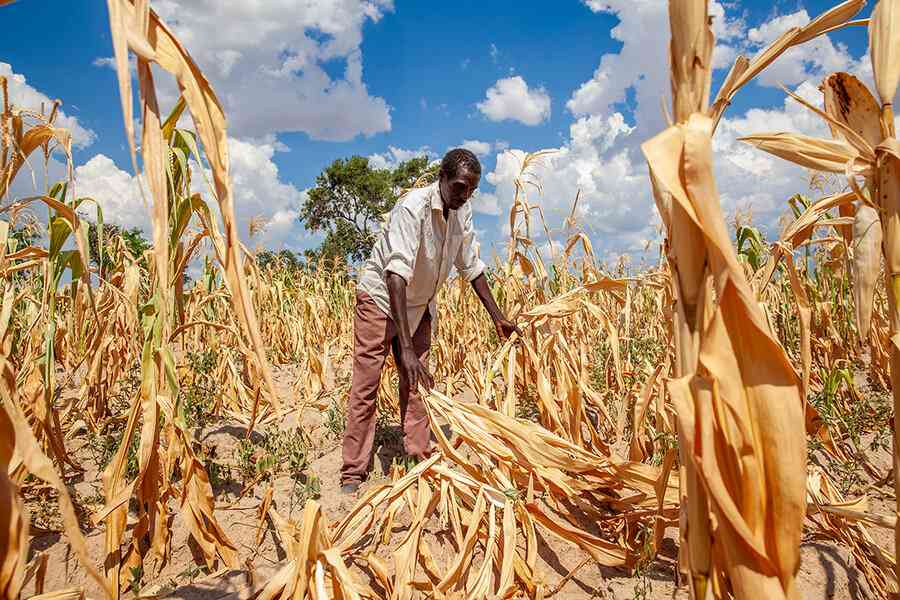
THE southern areas of the country, traditionally known to be dry and lying in agro-ecological regions four and five received above normal rainfall. This boosted agricultural productivity and greatly improved dam levels. However, this should not make the government forget about contingency plans should the country not get adequate rainfall in the coming seasons.
The Meteorological Services Department has already warned that the country may experience the El Nino phenomenon in the 2026-27 farming season and increased chances of below normal rainfall as well as drier conditions. Although the MSD indicated that the forecast is preliminary, authorities must start planning ahead.
From past experiences, we have seen the government claiming to have adequate food stocks only to sound alarm when crisis strikes.
Zimbabweans will remember former Agriculture minister Joseph Made for repeatedly making public statements claiming that the country had enough grain to cover national consumption. The former minister made these claims between 2001 and 2002, despite international agencies and agricultural bodies reporting deficits, and pushing for the United Nations to intervene.
Again in 2004, Made received backlash from fellow legislators after making similar claims at a time when the government was ordering thousands of tonnes of grain.
When top government officials make statements, most citizens tend to believe them. Hopefully, nothing of this sort will happen this time around.
The 2025-26 farming season had bountiful harvests, especially maize which is the country’s staple. The government, which usually does not pay farmers early must improve in how it conducts its business. Farmers must be paid well and timely. This will encourage them to deliver grain to the Grain Marketing Board (GMB). This will enable the government to work with accurate data on food stocks.
For years, the GMB has been accused of failing to pay farmers on time and yet most of them would require that money to prepare for the oncoming season. Gone are the days when people farm for subsistence. Farming is a business and the farmers expect payment for their deliveries. They have families to feed and pay school fees for, let alone paying employees who may be helping them on the land.
- Police, soldiers to raid maize hoarders
- Deputy minister in GMB theft scandal
- Private sector makes inroads into wheat production
- Police, soldiers to raid maize hoarders
Keep Reading
If the stocks are low, there will be adequate time this off-season for the government to augment them to ensure no one starves if the country does not receive adequate rainfall.
Good harvests from past seasons must not make the government complacent. Rather, they should give authorities room to build on current national stocks to ensure the country has adequate stocks should the season turn out to be bad.
Most of the country’s dams recorded 100% capacity at the end of the 2025 rainy season. This should push the government into action on irrigation development. The majority of farmers in Zimbabwe rely on rain-fed agriculture and the development of irrigation would lead to a profitable transition as better harvests can be ensured.
People can also farm all-year round ensuring food security, better nutrition and healthier lives for citizens.
These would be in line with the global sustainable development goals aimed at ending poverty, protecting the planet and ensuring prosperity. Zimbabwe has its own ambitious targets, including achieving an upper middle-income economy by 2030. Achieving this objective remains tough, judging by the current situation on the ground.
Investment in irrigation is the way to go and more resources must be allocated towards this.
It must be a national priority which, together with mechanisation, might transform the country’s fortunes. These programmes must be inclusive and should be initiated across the country.
Consequently, it means that rural transformation will be spread across the whole country and not made a preserve for selected districts. The programme should begin with districts that lie in drought-prone regions of the country which lie around agro-ecological regions four and five.
These include Chiredzi in Masvingo province, Hwange and Binga in Matabeleland North, Mudzi (Mashonaland East), Rushinga and Mbire (Mashonaland Central), Gwanda and Beitbridge (Matabeleland South) and Chipinge (Manicaland) among others.
There are several other agricultural programmes that have been introduced in Zimbabwe such as the climate-proof conservation agricultural model Pfumvudza/Intwasa which mainly targets smallholder farmers. However, it is labour-intensive and mechanisation will be more attractive for most farmers.
Past mechanisation programmes did not reach the majority of ordinary Zimbabweans but remained a preserve of the elites and politically-connected and yet initially, the programme was meant to benefit newly-resettled farmers. The resultant debt was later assumed by the government.
The mistakes and missteps made by Made and other like-minded officials belong to the past. They are never to be repeated but must stimulate the government into using the information it gets from its agencies and departments appropriately. This is what will make its decisions effective.
- Wilson is the founder and leader of the Democratic Official Party.