
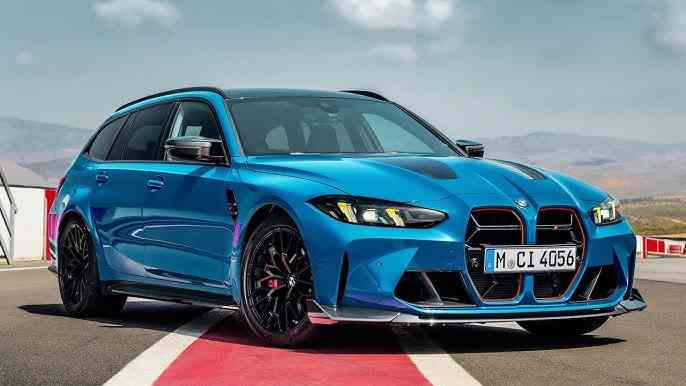
For decades, the one-car solution has been the ultimate goal of motoring. It is the elusive promise of a vehicle that can tear through a racetrack on Sunday morning, yet comfortably carry a family and their luggage across the country on Monday.
With the arrival of the BMW M3 CS Touring (G81) in the first quarter of 2026, that quest may finally have reached its endgame.
But at a local price point starting from R3,024,010, it enters a ceiling of pricing that demands more than just a badge and a big boot. It demands a justification of its engineering.
To understand why this wagon is priced roughly R800,000 north of the standard M3 Touring, is worth the investment, one must look past the spec sheet and into the obsessive mechanical refinement that defines the Competition Sport (CS) philosophy.
- The heart of the beast: More than just a tune
At the core of the M3 CS Touring is a masterfully reworked version of the 3.0-litre S58 twin-turbocharged straight-six.
In this iteration, BMW’s M division has pushed the output to 550 hp, a 20 horsepower bump over the Competition model, while maintaining a massive 650 Nm of torque.
However, the CS designation is about more than just a software remap.
The engine utilises a closed-deck crankcase design for extreme rigidity, allowing for higher combustion pressures.
- India to press Apple, Samsung for faster 5G software upgrades in phones
- Be at it dude
- MetaTrader 4 explained
- Why You Should Invest in Quality Software Engineering Tools and Methods
Keep Reading
The cylinder bores feature a wire-arc sprayed iron coating to reduce friction, and the crankshaft is a forged, lightweight unit. Perhaps most impressive is the cylinder head core, created using 3D printing techniques that allow for coolant duct routing that would be impossible with traditional casting.
This ensures that even under the sustained lateral G-forces of a track day, the engine remains perfectly cooled and lubricated.
- Physics-defying dynamics: The Nürburgring proof
The most startling justification for the price is the car’s official lap time at the Nurburgring Nordschleife.
Driven by development engineer Jörg Weidinger, the M3 CS Touring clocked a 7:29.490-minute lap.
To put that into perspective, this family wagon is faster around the Nurburgring than many dedicated supercars from the previous decade.
This performance is achieved through a bespoke chassis setup that cannot be retrofitted to a standard M3. The CS features unique axle kinematics and custom-tuned dampers, springs, and anti-roll bars.
Even the engine mounts are stiffer, with a spring rate of 588 N/mm compared to the standard 214 N/mm. This creates a more direct structural link between the drivetrain and the car’s body, resulting in a razor-sharp throttle response and a front end that bites into corners with surgical precision.
- The carbon fibre
Weight is the enemy of performance, especially in a wagon.
BMW’s engineers attacked the G81’s mass with the use of Carbon Fibre Reinforced Plastic (CFRP).
The CS features a carbon-fibre bonnet (saving 1.5 kg), front splitter, front air intakes, exterior mirror caps, rear diffuser, and a rear spoiler.
Inside, the weight-saving continues with standard M Carbon bucket seats and a centre console crafted entirely from CFRP.
While a total weight saving of roughly 15 kg to 20 kg might seem modest on a car weighing nearly two tons, the placement of that weight reduction is critical.
Lowering the centre of gravity and reducing unsprung mass through the forged M light-alloy wheels (19-inch front, 20-inch rear) transforms the car’s agility, making it feel significantly lighter than the scales suggest.
- Aesthetics with a purpose
Visually, the M3 CS Touring is unapologetic.
It inherits the yellow daytime running light icons from the M4 CSL, a nod to GT racing cars.
The frameless BMW kidney grille is stripped back to save weight and features red contour lines that signal its hierarchy in the M lineup.
The Titanium rear silencer is another highlight, not only shaving off several kilograms but providing a raw, metallic soundtrack that the standard steel exhaust cannot replicate.
It is a car that looks as fast as it is, but every scoop and winglet serves a genuine aerodynamic purpose, increasing downforce and cooling efficiency.
- Practicality meets the podium
This is where the M3 CS Touring truly justifies its existence over a dedicated sports car like a Porsche 911.
You have 500 litres of boot space, expandable to 1,510 litres with the rear seats folded.
It retains the signature BMW Touring independent rear window opening, allowing you to toss small bags into the back without opening the entire tailgate.
Inside, despite the racing focus, you are not deprived of luxury. The BMW Curved Display runs the latest Operating System, and the cabin is draped in Merino leather with Mugello Red accents.
It is a cockpit that feels like a multi-million rand environment, blending high-tech digitisation with old-school tactile carbon fibre.
The verdict: Why it’s worth R3 million
In the current automotive landscape, the analogue high-performance internal combustion engine is a sunset technology.
The M3 CS Touring represents the absolute peak of what is possible with this format.
You aren’t just paying for a faster wagon, you are paying for:
* Exclusivity: Production is strictly limited, ensuring strong value retention.
* Engineering depth: From the 3D-printed engine parts to the bespoke chassis tuning, this is a factory-integrated performance package no aftermarket tuner can match.
* Versatility: It is a car that can do the school run, the grocery haul, and a 7:29.490 Nürburgring lap in the same 24 hours.
For car enthusiasts who want the pinnacle of BMW M engineering without sacrificing the utility required for daily life, the M3 CS Touring isn’t just a car, it’s a landmark.
At R3,024,010 in the neighbouring country, South Africa, it is undeniably expensive, but as a final, glorious celebration of the pure petrol-powered M wagon, it is priceless.