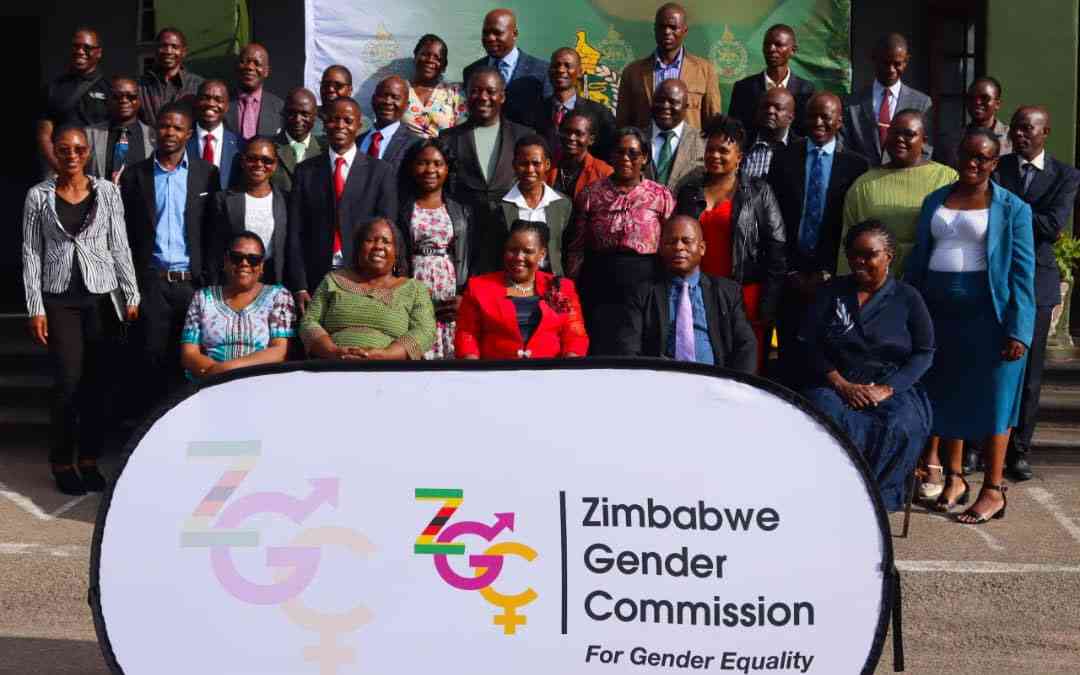
THE Constitutional amendment talk that has become a conversation piece at this material time in Zimbabwe is coming with the intention to transfer the functions of the Zimbabwe Gender Commission (ZGC) to the Zimbabwe Human Rights Commission (ZHRC).
Clause 17 of the Constitution of Zimbabwe (Amendment) Bill, 2026 says: “This clause repeals Part of 4 of Chapter 12 of the Constitution, which establishes the Zimbabwe Gender Commission.”
“Its functions will be transferred to the Zimbabwe Human Rights, since the ZHRC is already mandated to protect all human rights, including those currently under the purview of the Zimbabwe Gender Commission,” it states.
Going a stage further, Clause 18 says, “This clause inserts the Zimbabwe Gender Commission function under the Zimbabwe Human Rights Commission”.
It is the object of this opinion article to have a tooth-pick analysis, if not a rebuttal of this move to fold the functions of the ZGC into the ZHRC.
The ZGC was established against the background of promoting gender justice in Zimbabwe. It was, therefore, a visionary move by the drafters of the 2013 constitution to create a specialist commission.
The structural, behavioural and attitudinal conditions that sustain gender inequality are deeply intersectional.
As such, they require matrix mindsets, approaches that think and see beyond immediate efforts to salvage the fiscus.
- SRC welcomes Fifa decision on Zhoya
- Letters: Women representation faces hurdles
- Letters to the editor: Misgovernance bleeding our nation
- Mash Central chief pledges allegiance to ED
Keep Reading
The ZHRC which is seen as already covering ZGC’s mandate is a broad commission whose tapestry includes among other functions socio-economic rights, political freedoms, participation rights and protection rights.
The ZHRC is, therefore, already too pregnant to absorb the functions of the ZGC. The polemic that gender justice is already covered under human rights misses the bigger picture.
Admittedly, while gender justice or equality is about ensuring fairness and dignity for all citizens, regardless of whether they are men, women or non-binary, it cannot be addressed comprehensively under the ZHRC.
That breadth is exactly why a dedicated ZGC is a sine qua non or essential. Gender inequality affects everyone.
Women encounter systemic barriers in education, employment and safety and anchor the care economy without commensurate incentives — they, therefore, deserve compensatory justice.
Since gender is not just about women, men, too, face harmful stereotypes, cultural expectations and under-addressed issues of mental health stigma.
Arguably, a specialist commission ensures that all gender-related injustices - not just those affecting women are addressed and redressed with a note of precision.
The argument for retaining the ZGC is reinforced by international and regional efforts embodied in various conventions and declarations.
These include the Convention on the Elimination of All Forms of Discrimination Against Women (CEDAW) of 1979 and United Nations Security Council Resolution 1325.
It also resonates with the Sustainable Development Goals, particularly Goal 5 on Gender Equality, as well as the Beijing Declaration and Platform for Action.
At the regional level, it aligns with the Southern African Development Community (Sadc) Protocol on Gender and Development and the Protocol to the African Charter on the Rights of Women in Africa (Maputo Protocol).
The main thrust of these instruments is to guarantee comprehensive rights for women and girls, particularly across Africa.
Observably, Human Rights Commissions are broad, not deep. The Human Rights Commission, as mentioned earlier on covers everything from political freedoms to economic rights. Arguably, gender issues risk being eclipsed in this crowded agenda of the ZHRC.
Essentially, a gender commission provides the depth and sustained focus needed to address entrenched structural and underlying root causes of gender inequality. These inequalities straddle the lived experiences of men, women, boys and girls.
Where gender issues are concerned, accountability requires a dedicated and focused watchdog.
Pursuant to the above argumentation, ZGC cannot be built into ZHRC, because the latter is a generalist structure, where accountability may be blurred.
A stand-alone gender commission can be measured directly on progress in gender justice or equality.
With the ZGC effaced through incorporation into the ZHRC, omissions and failures risk being buried under the broader performance of the ZHRC. If at all there is for a merger of commissions, then it could be the Zimbabwe Electoral Commission (Zec) and the ZHRC blending into one because their mandates have a meeting point on human rights, political participation and political freedoms.
Pursuant to the above, if fusing commissions were truly about efficiency and protection of human rights, the Zec should be the first candidate for absorption.
Yet no one suggests that because everyone recognises the need for specialised focus. To single out the ZGC for merger is inconsistent and reveals the move is less about efficiency and more about downgrading gender equality.
Gender rights deserve more than a footnote.
Interestingly, will the Ministry of Women Affairs, Small and Medium Enterprises Development going to be folded into the ministry of justice? No.
Because the State recognises that gender issues require specialised policy, attention, resources and visibility. If we are stretching our imagination further, we are bound to ask, if gender rights can be erased into the human rights commission, then why not erase the Ministry of Women Affairs into Social Welfare?
It stands to reason that Zimbabwe’s Constitution created the gender commission deliberately, recognising that gender equality is foundational to justice.
For this writer that was and still is constitutional wisdom. The creation of the ZGC was, therefore, not duplication, it was indeed foresight.
The worst thing in life is to be born with sight but without vision, hence the debate on the intention to infuse the ZGC into the ZHRC should be approached with the vision of a giraffe, and not that of a frog.
The frog’s-eye-view with respect to the issue under discussion is retrogressive. To merge the ZGC now undermines the vision of the Zimbabwean people, who are the collective steward of the constitution and sets a precedent for dismantling other independent commissions under the banner of efficiency. Institutions are more than bureaucracies; they are signals of commitment.
The ZGC tells every citizen in Zimbabwe, female or male, boy or girl that their gender related and lived struggles warrant a dedicated guardian. In the same vein, folding the ZGC into the ZHRC sends the opposite message that gender justice is expendable.
In summation, it is worth noting that gender justice is not a men’s issue. It is a national issue that touches every citizen. To argue that it is already covered under human rights is to ignore the need for priority, expertise, accountability and visibility.
The ZGC is just as necessary to Zimbabwe as water is to fish. Zimbabwe needs a gender commission not because gender rights are separate from human rights, but because they are too important to be lost within them.
Nicholas is a concerned Zimbabwean, who believes gender justice is central to building a fair society for all.