
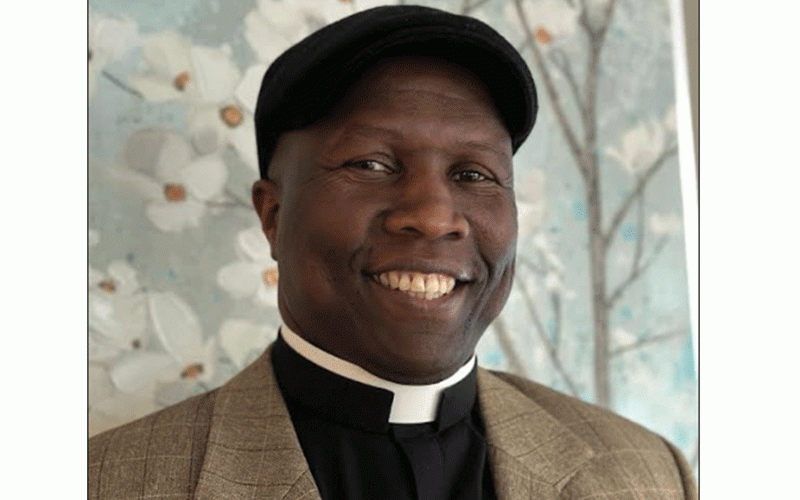
CANADA-BASED Zimbabwean cleric and academic Monte Tugwete (MT, pictured), whose book It’s Not Racism, It’s Hatred of a Different Skin Colour: A Meta-Analysis of the Root Cause of Racialised Oppression was recently reviewed by this publication, is more than a pastor and author. He is an accomplished academic who has taught human development at Rhodes Wellness College and leadership at Trinity Western University, and currently lectures in leadership, talent management and change management at University Canada West. Zimbabwe Independent’s Eddie Zvinonzwa (EZ) spoke to Tugwete on a wide range of issues, including racism, authorship and transculturalism. Below are excerpts from the interview:
EZ: Issues of race and race relations have been common for decades across the globe. Why has the pastoral approach not been able to eradicate the ill?
MT: Inequity has been systematised in such a way that this has been decsribed as a “systematised function of internal and external dynamics anchored in power and economics, steeped in history, culture and identity” (p27 of the book).
The way this works is that there are internalised systems deeply embedded in people’s psyches, which cause implicit bias, support privilege and cause internalised racism. Then, on the outside, there are systems that are institutional, interpersonal and structural. Whether you are aware of it or not, people benefit through the three things that I point out in the book: power, privilege and passage.
If you fall within the privileged group and you are benefiting, there is no way that you are going to let go of the power, the privilege and the ability to have passage, as these are to your advantage. This is such a strong phenomenon that current pastoral approaches have not recognised that they are fighting against it. This will not let up because no one wants to lose benefits, so we are far from eradicating this illness. If the pastoral thought process does not change to engage different approaches such as listening theology (to address the cognitive side of this issue), simple theology (to address the behavioural side of this issue), and affective theology (to address the affective side of this issue), then eradication of this illness will be in vain.
EZ: As someone who grew up in Zimbabwe, what differences do you see in how the southern African nation and the US have responded to racism?
MT: In the DEI (diversity, equity and inclusion) hermeneutic lenses that we use in the approach to this work, it is apparent that the genesis of the United States of America (US) was through slavocracy and plantocracy, which hinged on making chattel out of “othered” human beings of dark skin from Africa, based on the belief in a supposed “God-given” right to enslave them through the erroneous “Hamitic Curse” that we discuss in the book on page 95. Though there was the emancipation of the enslaved, the system, strongly informed by these roots, was — and is — hell-bent on maintaining these manufactured hierarchies, to the extent that it is only relatively recently that those of African descent were granted civil rights in 1964 via the Civil Rights Act, which outlawed discrimination based on race, colour, religion, sex or national origin. It ended segregation in public places, banned employment discrimination and accelerated school desegregation — all by-products of homegrown, full-on racism. Ever since then, there has been pushback against the gains of the Civil Rights Act of 1964.
In Zimbabwe, things changed drastically in 1980 when the country gained Independence from Britain, as laws were immediately revised when political power shifted to the Black majority. We did have our own form of segregation and apartheid, which was not as extreme as the US and South African versions. This left locals with the derogatory term “mabhoyi”, as mentioned in the book on page 8.
- Toxic environment driving away prospective female politicians
- Harry Belafonte, singer, actor and tireless activist, dies aged 96
- Meikles rocked by racism allegations
- Rethinking race: A pastor-scholar’s bold take on racism, cultural transformation
Keep Reading
EZ: There is a long list of victims of race-based aggression/hatred. Do you see this coming to an end anytime soon?
MT: The book cover art names the victims of race-based hatred, and that list was alarming then, and yet it has never ceased. It is even growing as we speak because the lifeworlds and the systemworlds demand it as payment to sustain themselves.
Those who live within this culture sometimes do not even see it as such. They even defend its existence and will do everything within their affected consciousness to perpetuate the status quo, especially if they belong to the non-targeted group.
There is a clever manipulation at play, which even allows those who, for example, are placed at ranking number two to run with the system, getting scraps, and then ensuring that those ranked number three remain there and never climb the ladder to threaten their position — let alone the number one position reserved for the super-elite. In doing so, they perpetuate the racialised oppressive system, which, if dismantled through collective effort, would benefit everyone from the abundance of resources that God has provided. Instead, the system forces everyone to operate with a scarcity mentality rather than an abundance mentality. This serves to perpetuate race-based aggression ad infinitum, meaning that without an approach that demystifies, demythologises and deconstructs, as advocated by the book, we are going nowhere very fast on this issue.
EZ: Let’s look at doing pastoral work in a foreign country. Are you also not a victim of these behaviours as an African?
MT: As I said earlier, a system that forces everyone to operate with a scarcity mentality will always leave a sour taste for those it affects.
Take, for example, “the talk” that one receives when it is known that you are going to be driving while Black in the US: keep your wallet with your identification in an easily reachable position in the car, never make sudden movements, and ask an officer if it is okay to take your hands off the steering wheel when you are stopped.
Some people may laugh at this, yet it can make the difference between life and death. It is shocking for someone who has driven while Black in other parts of the world and never had to think about such things at a traffic stop. Sometimes, even following these rules is not enough.
It does not matter that one is a pastor — the identity imposed by the system takes precedence. You could be coming from a lecture, a church service or a pastoral visit, but if “you fit the description”, then all logic is abandoned. This reality means that one lives with the awareness that any moment could be their last, as seen in the cases of Philando Castile and George Floyd.
EZ: How do you see race relations, especially Black-white relations, in the next 20 or so years?
MT: There is a silver lining. The work being done through the DEI approach, which now advocates for intercultural existence rather than multiculturalism, cross-culturalism and acculturation, is beginning to bear fruit. This is evident, for example, in the conviction of Derek Chauvin for the murder of George Floyd — a case that contrasts sharply with that of Emmett Till, whose killers were never convicted. While some may see this as a token victory, I view it as a seed for better things to come. We are working to move beyond intercultural, multicultural and cross-cultural frameworks towards transculturalism within the next 20 years. This concept advocates cultural fluidity, hybridity and the blending of cultures into new identities.
EZ: Besides pastoral work, what else do you do?
MT: I am an ordained minister in the Anglican Church of Canada, and yet some who know me are not even aware of this identity, as I have a way of sustaining multiple identities contextual to my work in the academy, which is informed by pastoral psychology, leadership and human development lenses that I bring to my analytical approach to issues. A long time ago, in the academy, there was no specialisation in areas of study; what we now call the interdisciplinary approach was the normal way of doing things. I have exciting research on leadership, especially leadership emergence, which I envisage as being informed by context and embodiment. I believe human development plays a significant role in leadership emergence as well. My research in this area is informed by a Zimbabwean context, as I am fascinated by some of the leaders, both current and historical, that Zimbabwe has produced over the years. This work, once published, will help to inspire up-and-coming Zimbabwean leaders to find their footing in their own leadership journeys. I am also mindful of the fact that I now reside in Canada and need to produce scholarly work that speaks to my current context. This is where my ability to engage with multiple disciplines comes into play. I have ongoing work based on Indigenous ways of knowing, informed by Indigenous moral traditions, which I intend to develop further in order to produce alternative approaches to issues affecting Canadian society, such as the troubled truth and reconciliation process. I am particularly drawn to this work because it engages with the attempted cultural genocide associated with the Canadian residential school system, which remains a deeply painful aspect of the country’s history. I am a scholar, teacher, pastor and avid researcher who reads widely. I strongly believe that reading and research are never wasted, as they can be drawn upon for future work. I value people and derive great satisfaction from seeing them realise their full potential. Whether in a pastoral or academic setting, I am known as a people-centred individual, as I believe everyone deserves to be led well.
EZ: What difficulties did you encounter in publishing this book?
MT: Self-publishing is not cheap, and being a first-time publisher brings challenges that must be navigated carefully. When one is relatively unknown and writing on issues that challenge established systems and advocate new ways of thinking, it requires tremendous effort to bring such a project to completion. This is why the book took me almost 10 years to develop from concept to a finished product. With more books in the same series — exploring difference as a precursor to oppression — in the pipeline, I intend to adopt a more efficient approach to the production process. This is the first of many works in this area, using difference as a starting point for examining and dismantling various forms of oppression through processes of demystification, demythologisation and deconstruction. As a student, family man and working professional, these responsibilities often intersect and can create competing demands. However, the ability to persevere through these pressures and produce meaningful scholarly work is what I will rely on as I move forward with future publications.
EZ: Where can people buy it?
MT: The book is currently available in print on Amazon, Barnes & Noble, Indigo and Walmart. An electronic version is available on Amazon Kindle, and it can also be accessed through various online platforms in different countries. Efforts are underway to make physical copies available in Zimbabwean bookshops on or before May 1, 2026. For more information, readers can visit montebooks.com for purchase links and an opportunity to leave feedback. Reviews on any platform where the book is purchased are greatly appreciated.
EZ: In terms of scholarship, your book adds to diverse views on attitudes and behaviours influenced by racial orientation. Your thoughts?
MT: This is true in the sense that my book approaches knowledge as being informed by lived experience, rather than relying solely on institutionalised systems of knowledge, which have often promoted the idea of distinct human races. In reality, there is only one race — the human race. These classifications are social constructs that have been used to create hierarchical systems. If one engages in listening theology and pays close attention to the metanarratives of those directly affected by racism, it becomes possible to understand the long-term, harmful effects these systems have had on people. My research places authentic human experience at the centre, using it as a foundation for rethinking how we approach this issue. Many lives have been lost as a result of actions shaped by both informal societal norms and formal institutional systems, all of which function to maintain oppression, as the book outlines. Historically, such rigid racial classifications did not exist in the way they do today, particularly in the United States. These constructs have since evolved to serve dominant power structures.