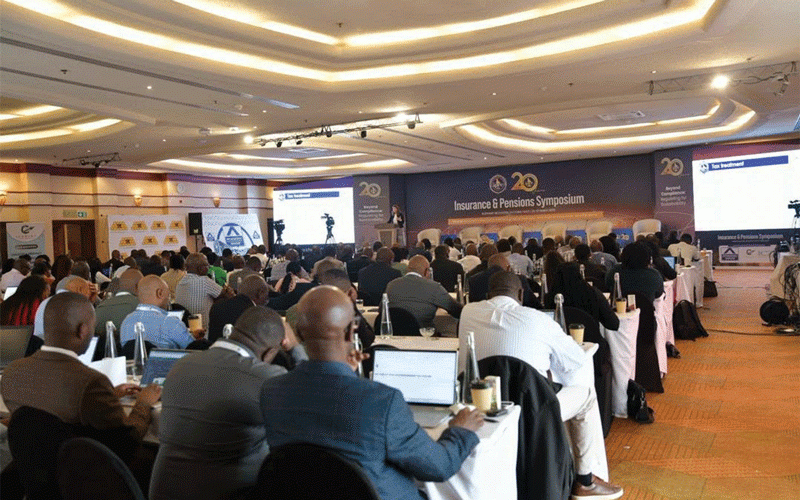

BEFORE the establishment of the Insurance and Pensions Commission (Ipec) in 2006, the regulation of insurance and pensions in Zimbabwe, from Independence in 1980, was administered within the Ministry of Finance, specifically under the Department of International Finance. This institutional arrangement reflected the nature of the sector at the time, relatively small in scale, with regulatory oversight centralised within government structures.
Under this model, governance and supervision were exercised directly by the ministry. The registrar and later, commissioner responsible for insurance and pensions operated within a defined administrative hierarchy, reporting through senior officials up to the Minister of Finance.
While this framework provided a measure of control and continuity, it was largely administrative in nature and constrained the development of specialised regulatory capacity required to effectively oversee a growing and increasingly complex financial sector.
Despite these limitations, the period laid an important foundation for the evolution of insurance and pensions regulation in Zimbabwe.
Several registrars and commissioners played key roles in shaping the regulatory landscape and maintaining oversight during this formative phase. These included Joseph Muzite, Albert Nduna (also served as Ipec board chairperson 2019-2026), Owen Tshabangu, Stanley Meda, Cornelius Nkomo, Clara Maya and Lovemore Mafurirano.
Notably, Mafurirano, who was the last commissioner under the Ministry of Finance in 2005, played a pivotal role in spearheading the transition from a ministry-based regulatory function to the establishment of an independent statutory authority, laying the groundwork for the formation of Ipec.
The birth of Ipec
The establishment of the Insurance and Pensions Commission was the culmination of a deliberate and visionary journey to strengthen the regulation of Zimbabwe’s insurance and pensions sector.
- UK based Zimbabwean divorces wife of 33 years over conjugal rights
- New perspectives: Money laundering red flags in insurance sector
- 3 000 non-resident pensioners owed US$1.5 million, says Ipec
- Removing barriers to women’s financial inclusion
Keep Reading
Although the Ipec Act [Chapter 24:21] had been promulgated as early as 2001, it was only in 2005 that this vision began to take tangible form with the appointment of the first board by the then Minister of Finance, Herbert Murerwa.
This marked the beginning of a historic transition, from a regulatory function embedded within government structures to the creation of an independent institution dedicated to safeguarding policyholders and pensioners. Yet, even with the board in place, the practical realities of separation took time.
For a brief but critical period, regulatory oversight continued under the Ministry of Finance, underscoring the complexity of building a new institution from the ground up.
In 2006, that vision was finally realised. The Ipec was formally hived off from the ministry, marking the true birth of Ipec as an autonomous regulator.
What began as an idea in legislation became a living institution, tasked with protecting the financial futures of millions of Zimbabweans. The commission started its journey within the Ministry of Finance at the New Government Complex before relocating to rented offices, Finsure House along Kwame Nkrumah Avenue in Harare, its first home as an independent entity.
The early days of Ipec were defined by humility, determination and a strong sense of purpose.
The commission was established with a once-off government grant of Z$5,8 billion, disbursed in two tranches in December 2005 and February 2006. With this funding came the most basic tools for operation — office furniture and a single operational vehicle, symbolic of a young institution taking its first steps with limited resources but boundless ambition.
What began with one pioneering Ipec
employee — Cheers Mudyanadzo and 16 officers seconded from the Ministry of Finance who remained on the government payroll until August 2006, would eventually grow into an institution that today stands as a cornerstone of Zimbabwe’s financial sector.
A defining moment in the establishment of Ipec was the appointment of Manett Mpofu as the first Ipec commissioner effective May 1, 2006. Her appointment marked the beginning of executive leadership for the commission and set the foundation for building a fully-fledged, independent regulator.
Under her stewardship, the commission began the challenging but vital task of building credibility, establishing systems and asserting its role in an evolving financial landscape.
Looking back, the birth of Ipec is more than a historical milestone. It is a story of vision, courage and institution-building against the odds.
It is this journey, from humble beginnings to national significance that defines Ipec’s legacy and inspires its future.
Significance of establishment of Ipec
The establishment of the commission marked a fundamental shift in the regulation of Zimbabwe’s insurance and pensions sector. It introduced institutional independence, enabling focused supervision, stronger governance frameworks and dedicated policy development. This marked the beginning of a new regulatory era anchored on professionalism, accountability and sector development.
From inception, the commission was tasked not only with regulation, but also with rebuilding confidence in a sector that had been severely impacted by macroeconomic instability. This dual responsibility shaped the commission’s journey over the next two decades.