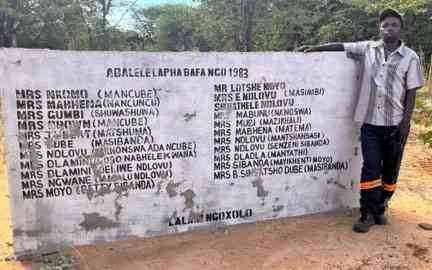
INTENSE debate erupted this week, ahead of Zimbabwe’s 46th Independence celebrations, as President Emmerson Mnangagwa’s administration spread the message of relentless economic recovery to Maphisa Growth Point in Matabeleland South.
Strikingly, Maphisa sits at the heart of a region still scarred by unresolved legacy of the Gukurahundi massacres, where an estimated 20 000 civilians were killed, with survivors still to find closure.
As Mnangagwa prepared to lead the commemorations, a fierce national conversation took hold over the widening gulf between glowing economic statistics and the lived reality of millions trapped in deepening hardship.
For the administration, the numbers appeared compelling. Gross domestic product (GDP) surged to over US$50 billion last year, from about US$18 billion at the time Mnangagwa’s Second Republic came to power in 2017.
Inflation, once entrenched in triple digits, has retreated into single digits, while the Zimbabwe Gold (ZiG) has exhibited relative exchange rate stability, powered by tight monetary policy and fiscal restraint.
On paper, it is a recovery story, but in reality, it is an illusion millions cannot eat.
“This administration has put overemphasis on growth metrics such as GDP instead of human development, basic services, and poverty eradication,” said leading political analyst Vivid Gwede
“As a result, Zimbabweans are told the economy is growing but they cannot feel any positive change in their livelihoods. It is therefore a jobless and people-less economic development trajectory,” said Gwede.
- Ziyambi’s Gukurahundi remarks revealing
- Giles Mutsekwa was a tough campaigner
- New law answers exhumations and reburials question in Zim
- Abducted tourists remembered
Keep Reading
The shocking disconnect between authorities’ statistical progress and human suffering now defines Zimbabwe, as it turns 46 tomorrow.
This week, other leading economists argued while authorities highlight stabilisation, structural weaknesses remained deeply embedded.
Zimbabwe’s long troubled currency continues to inspire little confidence, forcing the Reserve Bank of Zimbabwe to make bold measures in the past few weeks by introducing new notes with improved quality, to deal with plummeting confidence.
Dollarisation dominates the economy, with over 80% of deposits, loans, and transactions conducted in US dollars. Even government services — from passports to fuel — remain priced in foreign currency, exposing the limits of a currency holding a shattered nation spellbound.
In an analysis this week, Zvikomborero Sibanda, an economic analyst at Mqabuko Capital, warned that ZiG stability remained fragile and potentially misleading.
“Honesty is essential given the context,” he said (See feature on Page 6).
“ZiG lost roughly half its value in its first year… Deep dollarisation remains a significant issue.”
He added that unless authorities confront the twin failures of fungibility and convertibility, the currency risks following the path of previous failed regimes.
“Historically, Zimbabwe has been a graveyard for monetary ambition,” Sibanda noted.
If the currency reflects fragility, the social sectors expose collapse.
The healthcare system — once a regional benchmark — is now buckling under chronic shortages of drugs, outdated equipment, and recurring strikes by underpaid staff. For many Zimbabweans, access to quality care has become a privilege rather than a right.
“The health sector is clearly in the proverbial intensive care unit,” Gwede said.
Beyond hospitals, the crisis is visible in the struggle for food.
The Famine Early Warning Systems Network warned two weeks ago that Zimbabwe is under renewed strain, with large parts of the country facing worsening food insecurity.
“Deficit-producing areas… continue to face crisis outcomes due to depleted own-produced food stocks, high market prices and below-average incomes,” the agency said.
For a country that once fed southern Africa, the warning is not just economic but a national indictment.
Erratic weather patterns, policy inconsistency, and structural decay have steadily eroded agricultural resilience. A poor start to the season damaged crops. Late rains introduced new threats — rot, sprouting, reduced yields. Even where harvests improve, weak incomes mean many households remain one shock away from hunger.
At the same time, rising fuel prices are rippling through an economy struggling to confront a sea of headwinds.
The latest wave of instability is driving up transport costs, and basic commodity prices. Public transport fares have surged sharply, blamed on the war in Iran, but business leaders said last week the crisis was already visible even before the US-Iran war broke out.
Inflation, though subdued compared to past crises, remains a concern.
The pressure on households is relentless.
Even traditional lifelines are faltering. The tobacco marketing season — a key source of rural income — has delivered weaker returns, with prices reported to be at least 20% lower than last year. For thousands of families, that means less cash, less food, and fewer options.
Yet, amid this strain, the government continues to project confidence.
Some analysts acknowledge progress. Economist Esther Mapungwana pointed to declining inflation and tighter monetary policy as signs of stabilisation.
“Inflation has dropped significantly… boosting confidence in the economy,” she said. In the most recent wave of positive looking statistics, during the 12 months to December 2025, the interbank and alternative market exchange rates remained stable, with only a marginal appreciation of 3% to US$1;ZiG26,45. The exchange rate premium, narrowed to around 20% at the end of 2025, from 35% in January, powered by a tight monetary policy blamed by bankers this week for frustrating growth. Month on month ZiG inflation averaged 1,3% last year, as the year on year rate plummeted from a peak of 95,8% in July 2025 to 15% by December.
Economists said stability without inclusion is fragile, and growth without jobs is remains unreal. They said discipline without delivery breeds resentment. Efforts to re-engage the international community have yielded little. Zimbabwe remains outside the Commonwealth of Nations, with limited progress despite years of diplomatic overtures. Gwede warned that without meaningful reform, that stalemate will persist.
“The re-engagement efforts are in their eighth year, but nothing of note has been achieved,” he said.
At home, political tensions are rising as the government pushes to extend Mnangagwa’s tenure beyond 2028 through Constitutional Amendment Bill No. 3, which has deepened concerns about governance and accountability. With the opposition weakened following turmoil within the Citizens Coalition for Change, analysts say the space for democratic contestation is narrowing. Political analyst Tendai Manzvazvike said meaningful reform remains essential.
“For Zimbabwe’s Second Republic to function as a multi-party democracy to the letter, reforms need to target the rules, institutions, and political culture that shape competition,” she told the Zimbabwe Independent.
Meanwhile, deeper structural constraints persist. Zimbabwe’s US$23 billion debt continues to block access to concessional funding. Corruption, infrastructure deficits, and policy inconsistency weigh heavily on investor confidence, although significant efforts are underway to repair neglected roads and other key national assets.
“We have resource leakages through corruption, high levels of indebtedness… and a high business risk profile,” Gwede said. “These are more fundamental and will need to be addressed.”
As Independence Day approaches, the symbolism of Maphisa Growth Point cannot be ignored. This is a place where history still demands answers — where the promises of independence were violently interrupted, and where closure remains elusive.
Bringing the celebrations here, without resolving that past, sharpens rather than softens the national contradiction.
Zimbabwe’s economy may be expanding on paper. But across the country, the lived reality is stark — empty cupboards, strained hospitals, rising costs, and a currency still fighting for trust.
observers say at 46, Zimbabwe does not suffer from a lack of data. It suffers from a lack of honesty.
They said until that changes, the gap between promise and reality will not just widen, but it will define the nation.
Shwane University public affairs professor Ricky Mukonza noted that fostering democracy in Zimbabwe, which has experienced contested polls, required key electoral reforms.
"There are several political reforms that I think are necessary to make Zimbabwe a multi-party democracy that allows people to exercise their political rights freely. I think the first one relates to electoral reforms. We know that one of the blights of Zimbabwean politics relates to disputed elections successively,” Mukonza said.
"It is important that we at least have elections that reflect the will of the people without some of the shenanigans that we hear of and we see in the body politic of Zimbabwe. The first thing, for example, would be to ensure that ZEC is a professional body that is truly independent, staffed by men and women who have been chosen on merit, so that even when they conduct their business, their conduct is not misconstrued as biased towards this actor or that actor," he added.
Farai Marapira, director of information at the ruling Zanu PF, said, “President Mnangagwa has delivered landmark achievements. Politically, we have successfully re-engaged the international community, dismantled corruption through ZACC, fully implemented devolution, and maintained peace and rule of law despite illegal sanctions”.
“Economically, the Second Republic has transformed agriculture via Pfumvudza, achieving food self-sufficiency with record wheat and maize harvests. Major infrastructure projects such as the Beitbridge-Harare Highway, Robert Mugabe Airport, Trabablas Interchange and Lake Gwaii Shangani are complete or advancing. The introduction of the ZiG currency has stabilised prices, while mining and manufacturing booms”.