Zimbabwe is intensifying efforts to unlock climate finance as international partners step up support to strengthen the country’s capacity to design and deliver investment-ready green projects amid escalating climate pressures and a widening funding gap.
The Global Green Growth Institute (GGGI), in partnership with the Swedish International Development Cooperation Agency (Sida) and the Embassy of Sweden in Harare, last week hosted a five-day climate finance capacity building workshop in the capital under the Leveraging Investments and Finance for a Green Transition (LIFT) programme.
More than 50 participants from government ministries, financial institutions and development partners attended the workshop, which focused on strengthening institutional capacity to mobilise and access climate finance.
The initiative comes as Zimbabwe continues to face recurrent droughts, land degradation and growing climate variability, while pursuing ambitious commitments under its revised Nationally Determined Contribution (NDC 3,0).
However, climate finance mobilisation — estimated at US$121 million over four years — remains significantly below national requirements.
The workshop is intended to equip national institutions with technical skills to translate climate priorities into bankable projects and funding proposals, thereby improving Zimbabwe’s ability to compete for global climate funding.
Launched at the Second African Climate Summit in September 2025, the LIFT programme is designed to strengthen climate finance readiness and project preparation capacity across Africa, with the Harare workshop representing one of its first major in-country implementation engagements.
In a statement, organisers said the programme is focused on building technical capacity to enhance access to climate finance and improve project preparation systems across participating countries.
- Chamisa under fire over US$120K donation
- Mavhunga puts DeMbare into Chibuku quarterfinals
- Pension funds bet on Cabora Bassa oilfields
- Councils defy govt fire tender directive
Keep Reading
“The workshop aims to support national institutions in developing the technical skills required to translate climate priorities into investment-ready projects and funding proposals,” the statement said.
“The LIFT programme, launched by Sida and GGGI at the Second African Climate Summit in September 2025, was designed precisely to strengthen climate finance readiness and project preparation capacity across Africa. The Harare workshop marks one of the programme’s first major in-country capacity-building engagements,” it added.
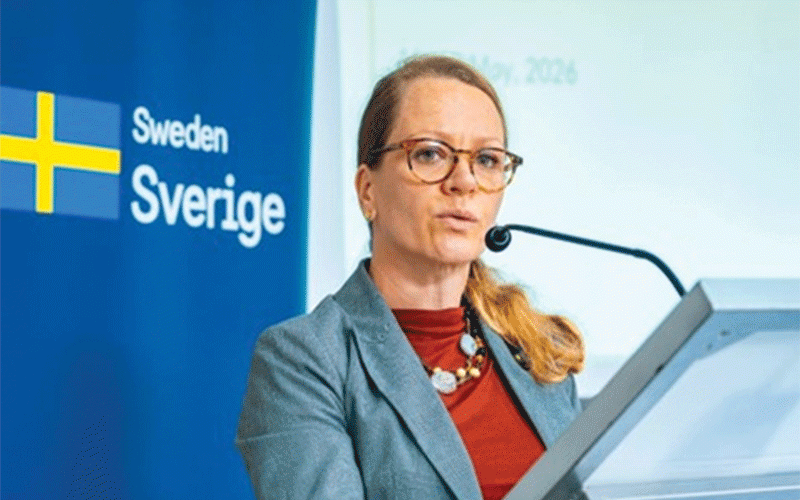
Opening the workshop, Deputy Head of Mission at the Embassy of Sweden in Harare, Emili Kinloch-Perez, emphasised the importance of broad institutional participation and capacity building in accessing climate finance.
“Climate finance is no longer only an environmental issue. It is central to building resilient economies, strengthening food systems, supporting sustainable infrastructure, creating jobs, and unlocking innovation and investment for the future,” she said.
She added that success in accessing climate finance depends not only on funding availability but also on the ability to develop credible and well-structured projects.
“Experience across Africa shows that access to climate finance depends not only on the availability of funding, but also on the capacity to prepare strong projects, navigate complex financing mechanisms, and build credible investment pipelines,” she said.
Counsellor and Team Leader of the Regional Team Environment at the Embassy of Sweden in Nairobi, Ulrika Åkesson, said coordinated action among stakeholders was essential.
“Climate finance cannot be mobilised by one institution acting alone. Governments, financial institutions, donors, the private sector, and technical partners all have a role to play. Strong coordination and shared understanding are essential if we are to build credible pipelines of transformative climate investments,” she said.
She added that the initiative would strengthen Zimbabwe’s access to multilateral climate funding and improve its overall climate finance architecture.
Speaking on behalf of Zimbabwe, Acting Deputy Director in the Ministry of Environment, Climate and Wildlife, Munashe Mukonoweshuro, said the programme aligned with national development priorities.
“As government, we are particularly encouraged by the focus on developing a pipeline of high-quality climate projects capable of attracting international support and investment, in line with achieving targets set in our NDC 3.0 Country Statement and National Climate Change Adaptation Plan (NAP) ... and ultimately Food Security, Climate Resilience, and Environmental Protection as prioritised in Zimbabwe’s National Development Strategy (NDS) 2.
Project preparation capacity is essential if Zimbabwe is to fully leverage the opportunities emerging within the evolving global climate.